
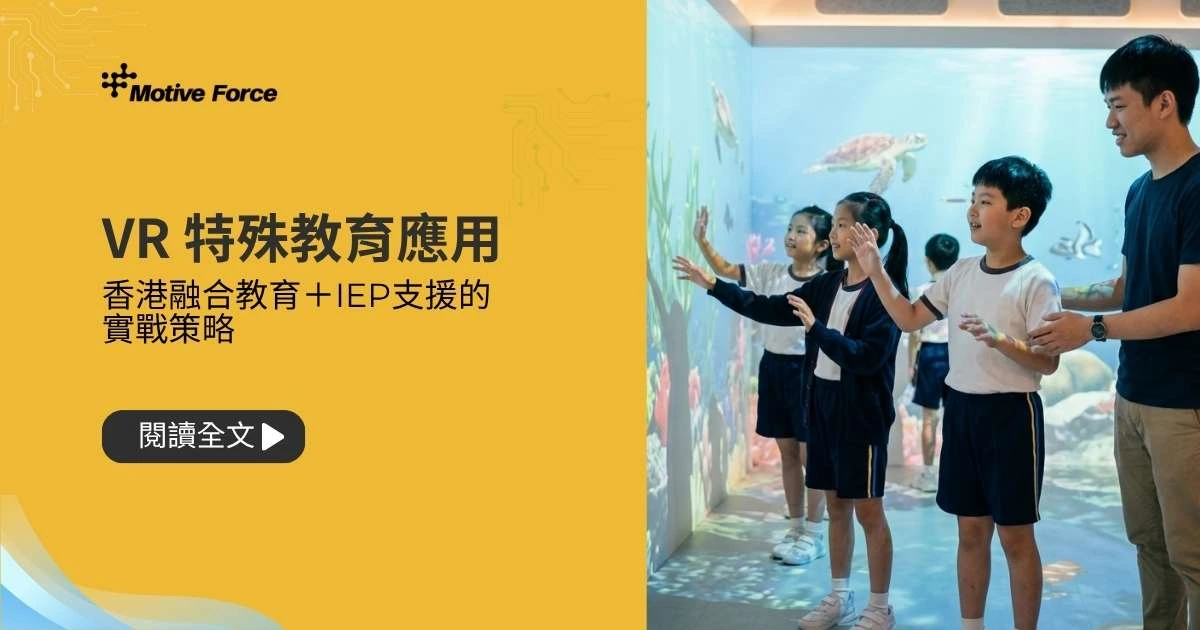
VR Special Education Application | Practical Strategies for Hong Kong Integrated Education + IEP Support
When communicating with frontline teachers, many shared a true observation: the direction of integrated education in Hong Kong is quite clear, and schools are actively promoting support measures in the hope of creating a more equitable learning environment for students with special educational needs (SEN). With the support of Education Bureau (EDB) policies and the Disability Discrimination Ordinance, inclusive education is gradually developing in depth.
At the same time, as students' needs become increasingly diverse, teaching sites continue to explore more effective and flexible support methods so that individual differences can be taken care of in more detail.
In this context, a question worth thinking about is:
How to further improve teaching effectiveness on the existing basis and optimize the support model for teachers and professional teams?
Virtual reality (VR) technology provides a promising development direction.
1. Starting from policy: VR strengthens the practical ability of integrated education
Hong Kong’s integrated education takes “school-based support” as its core and cooperates with the three-tier support model (Tier 1–3):
Tier 1: Whole class support
Tier 2: Small group support
Tier 3: Individualized Support (IEP)
Based on this mature framework, VR technology can play a role in amplifying benefits:
Assist in standardizing Tier 2 and Tier 3 training processes
Make IEP learning goals more specific and easier to understand
Provide diverse and repeatable simulated learning situations
For example, students with autism can use the immersive environment to practice daily social situations, such as saying hello, waiting in line, etc. This kind of "hands-on" learning helps students apply skills more naturally to real-life situations.
2. Immersive learning: from “explanation” to “experience”
A major problem in traditional SEN teaching is that students have difficulty understanding abstract concepts. VR can just meet the teaching needs in this area:
Improve understanding through contextual learning (e. g. shopping, riding a car)
Combine visual and sound stimulation to strengthen memory connections
Provide instant feedback and promote active participation
Visible results in practice include:
Improve concentration and engagement
Help students build confidence in new environments
Increase learning motivation and successful experience
Learning is therefore further transformed from "understanding content" to "accumulating experience", and the effect is more profound.
3. IEP digitization: Make learning results more clear and visible
IEP (Individual Learning Plan) is an important foundation for inclusive education, and VR technology can further strengthen its implementation and evaluation:
Automatically record the learning process (such as reaction time, selection performance)
Generate visual progress reports
Performance comparison before and after support
This kind of data not only helps improve the consistency of assessments, but also makes it easier for teachers and parents to track student progress.
At the same time, data support is also consistent with the direction of "evidence-based teaching" advocated by the Education Bureau, giving schools a more reference basis when planning and reviewing support strategies.
4. Life skills and career planning: extending from the classroom to the future
As Hong Kong attaches great importance to "life planning education", the life and career preparation of SEN students are also receiving increasing attention. VR can play a bridging role:
Mock interviews and work situations
Experience office or service industry processes
Practice using public transport and community facilities
The value these experiences bring includes:
Provide a safe and low-pressure practice space
Support trial and error
Build confidence and adaptability
Students can gradually accumulate successful experiences before entering the real environment, making the transition smoother.
5. Supporting the teaching profession: Let’s return to “student-centered”
In an environment with diverse learning needs, teachers and related professionals have been actively optimizing teaching methods. The positioning of VR is exactly a support tool:
Provide structured teaching activities
Assist with repetitive training
Allow teaching assistants to participate in implementation
Through the cooperation of technology, the teaching process becomes smoother, and teachers can devote more time to observing students, building relationships and providing individual guidance.
6. Steady advancement: gradually practice innovative applications
With the development of educational technology, the application of VR in schools can also be promoted step by step. When implementing, consider:
Making good use of government funding (from the Quality Education Fund (QEF) to various innovation and technology grants, all provide solid support for schools to introduce VR. )
Arrange professional training to meet the development needs of T-standard+
Gradually expand through small-scale pilots
Establish collaboration with rehabilitation or social welfare organizations
At the same time, the usage is adjusted according to the needs of different students to ensure that the learning experience is comfortable and effective.
7. Future Prospects: Toward a More Comprehensive Integrated Education
When VR is further integrated with Hong Kong’s integrated education policy, it is expected to bring optimization in many aspects:
IEP moves from file management to dynamic learning system
The support model is more forward-looking and preventive
A more flexible and inclusive learning experience
More importantly, integrated education will not only be a policy direction, but a teaching model that is continuously practiced in the classroom and has visible results.